Trading Confluence Framework for Reading Price Action
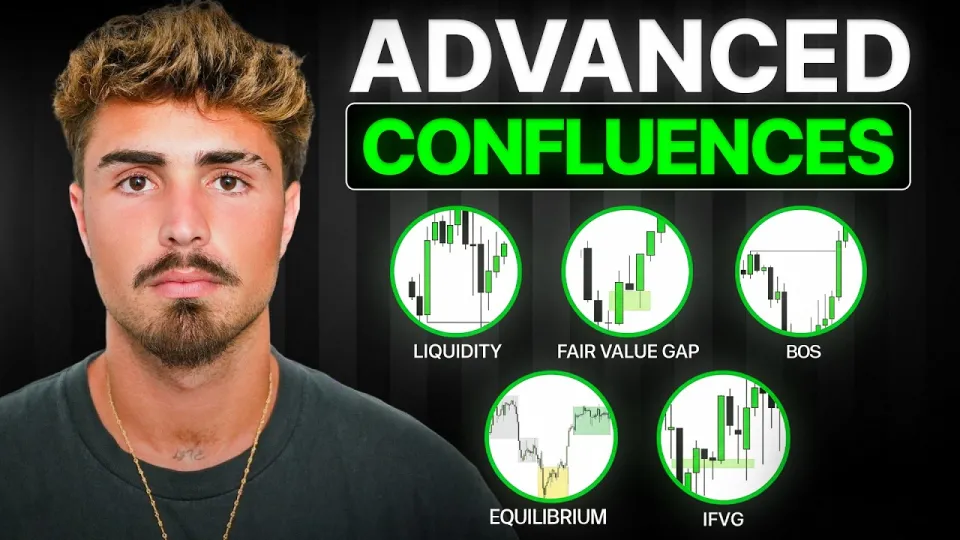
Video: Learn Every Trading Confluence In 18 Minutes
Need articles like this for your video? They help promote it on YouTube and Google — order them in the Telegram bot @sat_sit_bot. Articles with your video embedded are written and posted by the bot itself — on popular topical sites (no ads). Try it free: 50 articles on us.
Trading confluence is the practice of waiting for several independent signals — liquidity sweeps, fair value gaps, inverse FVGs, equal highs and lows, and break of structure — to align before entering a position. Instead of trading one pattern in isolation, a confluence trader treats each signal as one piece of evidence and only acts when the evidence stacks in the same direction. TJR's breakdown of these concepts in a single session is a useful map of the toolkit; the full framework is outlined at the TJR blueprint page.
Why trading confluence beats single-pattern setups
A single candlestick pattern or indicator cross fires dozens of times a week and most of those signals are noise; confluence filters them down to the handful of moments where order flow, structure and imbalance agree. The logic is simple: if liquidity has just been swept, a fair value gap sits behind price, and structure has broken in the same direction, the probability that the next leg continues is higher than if only one of those conditions were true. Traders who rely on one signal tend to over-trade and then blame the strategy; traders who require two or three confluences naturally trade less and accept fewer, better-quality entries.
The practical rule is to define, in advance, which confluences are mandatory for your setup and which are optional bonuses. A common hierarchy looks like this:
- Higher-timeframe bias — are you looking for longs or shorts today?
- Liquidity event — has price swept a known pool of stops?
- Imbalance — is there an unfilled fair value gap or an inverse FVG to trade from?
- Structure — has a break of structure confirmed the direction?
- Entry trigger — a lower-timeframe confirmation inside the zone.
If any of the first four is missing, the trade is skipped. That single rule removes most of the frustration that comes from chasing candles.
Liquidity: the pool price hunts first
Liquidity is the collection of resting orders — stop losses and pending entries — that market makers and larger participants need in order to fill size, and price is drawn to it before making a real move. In practice, liquidity sits above equal highs, below equal lows, at obvious round numbers, and around the highs and lows of the previous session. When price pushes through one of those levels and immediately reverses, that is a liquidity sweep, and it is one of the strongest single confluences available because it tells you who just got trapped.
How to use it:
- Mark equal highs and equal lows on your chart; they are visible targets that other traders see too.
- Wait for the sweep, not the approach — entering before the level is taken is guessing.
- Combine the sweep with a displacement candle in the opposite direction; a slow drift through the level is usually continuation, not a reversal.
- Treat the swept level as your invalidation point: if price closes back beyond it, the idea is wrong.
Fair value gaps and inverse fair value gaps
A fair value gap is a three-candle imbalance: when the body of the middle candle moves so fast that a gap is left between the high of the first candle and the low of the third, price has skipped a range without two-sided trade. Markets tend to return to that inefficient area to rebalance it, which is why FVGs act as magnets and as entry zones. The mirror applies for bearish gaps, where the range sits between the low of the first candle and the high of the third.
An inverse fair value gap is what happens when a fair value gap fails. If price trades through a bullish FVG and closes below it, that zone flips and can now act as resistance; the same logic works in reverse for a bearish gap turning into support. The IFVG matters because it shows a change in who is in control — the traders who defended the original gap have been overrun.
A workable checklist for gap trades:
- Identify a clean FVG created by a displacement move, not by choppy overlapping candles.
- Note whether price approaches it after a liquidity sweep or out of nowhere; the former is far stronger.
- Enter on the first return into the gap, with the stop beyond the far edge of the zone.
- If the gap is violated and price closes through it, stop treating it as support or resistance and start watching for the inverse setup.
Equal highs, equal lows and break of structure
Equal highs and equal lows are price levels that get tested two or more times without a clean break, and they matter because they concentrate stop orders in one place. A double top that looks like resistance is often just a liquidity shelf; the real move frequently begins after that shelf is taken out. This is why experienced traders rarely short into equal highs blindly — they wait to see whether the level holds or gets swept.
Break of structure is the confirmation tool that ties the whole framework together. A bullish BOS occurs when price closes above a meaningful swing high, signalling that the sequence of lower highs has ended; a bearish BOS is the mirror. The details that separate a real break from a fake one:
- Use candle closes, not wicks, especially on the timeframe you are trading.
- Require displacement — a strong candle with little overlap — rather than a grind through the level.
- Check that the break happens after liquidity has been taken; a BOS into an untapped liquidity pool often reverses.
- After a BOS, the natural entry is a pullback into the nearest fair value gap or order block left behind by the break.
Combining confluences into a repeatable process
The value of confluence is not in collecting signals but in sequencing them, because each one answers a different question. Bias answers "which direction", liquidity answers "where did the trap happen", the FVG answers "where do I enter", and the BOS answers "is the move confirmed". A simple sequence that works across futures, forex and crypto:
- Set the higher-timeframe bias from the most recent break of structure.
- Wait for price to sweep a liquidity level in the opposite direction of that bias.
- Look for a displacement candle that leaves a fair value gap.
- Enter on the retrace into the gap, stop beyond the sweep, target the next liquidity pool.
- If the gap flips into an inverse FVG, use it as a continuation entry rather than fighting the new direction.
Risk management is the part that makes any of this survivable: a fixed percentage risk per trade, a defined reward-to-risk target, and a hard limit on daily losses. Many viewers of TJR's breakdown note that the concepts only start paying off once discipline and risk-to-reward are treated as seriously as the patterns themselves — a point worth repeating, since no confluence saves a trader who sizes positions emotionally.
Common questions traders raise about confluence
Does every trade need all five confluences? No. Most profitable setups use two or three, and requiring all five will leave you with almost no trades. The key is deciding in advance which combination you will accept and then executing it consistently.
Can confluences be used on any timeframe? Yes, but they behave differently. On higher timeframes the signals are fewer and more reliable; on lower timeframes they appear constantly and demand faster decisions, so beginners usually do better starting on the 15-minute or 1-hour chart.
How do you avoid over-analysing the chart? Limit yourself to a fixed toolkit — liquidity, FVG, IFVG, equal highs and lows, BOS — and ignore everything else. Adding indicators every time a trade fails is a symptom of missing process, not missing tools.
What matters more, the setup or the trader? The trader. Two people can take the same fair value gap entry and get completely different results based on position sizing, patience and whether they follow their own rules. Learning the concepts takes an afternoon; building the discipline to apply them takes months of screen time.
Useful links
- TJR trading blueprint
- Indicators used by TJR
- Funded account raffle entry
- Alpha Futures funded accounts, 10% off
- Lucid Trading, 40% off
Final thoughts
Confluence trading works because it replaces prediction with a checklist: liquidity tells you where the trap is, fair value gaps and inverse FVGs tell you where to enter, and break of structure tells you whether the move is real. None of these tools is complicated on its own, and that is exactly why the discipline of combining them is the hard part. The TJR channel condenses this framework into a short, practical walkthrough that is worth revisiting alongside your own charts. If you want the structured version, start with the TJR blueprint and build your rules before you build your position size.
Key takeaways
- Confluence means stacking independent signals (liquidity, FVG, IFVG, equal highs/lows, BOS) before risking capital on a trade.
- Liquidity is the pool of resting orders above equal highs and below equal lows that price often seeks before reversing.
- A fair value gap is a three-candle imbalance where price moved fast enough to leave an unfilled range between candle one's high and candle three's low, or the mirror for shorts.
- An inverse fair value gap is a failed FVG that flips from support to resistance, or the reverse, and often marks a continuation entry.
- Break of structure confirms a shift in market direction only when a swing high or low is taken out with a close beyond it, not just a wick.
Source: Learn Every Trading Confluence In 18 Minutes · Markdown version
Questions & answers
What is a confluence in trading?
A confluence is a point where two or more independent signals agree on the same trade direction, such as a liquidity sweep followed by a fair value gap and a break of structure. Traders use confluences to filter out weak setups and trade only when the evidence stacks up.
How many confluences should a trade have?
Most practical setups rely on two or three confluences rather than all of them. Requiring every signal at once leaves almost no trades, so decide in advance which combination fits your strategy and execute it consistently.
What is the difference between a fair value gap and an inverse fair value gap?
A fair value gap is an unfilled imbalance left by a fast move, and it often attracts price back for a retest. An inverse fair value gap is that same zone after price has closed through it, which flips it from support to resistance or the reverse and can be used for continuation entries.
Why do equal highs and equal lows matter?
They concentrate stop orders in one area, which makes them a target for liquidity. Price often sweeps those levels before reversing, so waiting for the sweep instead of shorting or buying into the level blindly improves the odds of the setup.